Intravascular Laser Irradiation of Blood (ILIB) on Sleep Quality Improvement: A Randomized Placebo-Controlled Clinical Trial

Abstract
Introduction
Sleep quality is a fundamental determinant of human health and well-being. Modified Intravascular Laser Irradiation of Blood (ILIB), a non-invasive therapeutic modality, has emerged as a potential intervention for sleep-related disturbances. Proposed mechanisms include reduced blood viscosity and platelet aggregation, activation of superoxide dismutase, increased oxygen bioavailability, enhanced microcirculation, elevated serotonin levels, and decreased cortisol concentrations—physiological processes intricately involved in sleep regulation, mood modulation, and the stress response.
Objective
To evaluate the effects of Modified Intravascular Laser Irradiation of Blood (ILIB) on sleep quality in individuals with self-reported sleep disturbances.
Methods
A randomized, placebo-controlled clinical trial was conducted with participants who reported poor sleep quality. Subjects were randomly assigned to one of two groups: the intervention group received ILIB using a 660 nm red laser, while the control group received a placebo treatment (light emission with sub-therapeutic power, <1 mW). Both groups underwent the same treatment schedule. Sleep quality was assessed at baseline and after six treatment sessions using the Pittsburgh Sleep Quality Index (PSQI) and the Epworth Sleepiness Scale (ESS).
Results
Participants in the ILIB group showed statistically significant improvements in the primary outcome of global sleep quality. PSQI scores decreased from 10.24 at baseline to 6.47 post-treatment. ESS scores showed a non-significant change from 10.44 to 10.12. These results suggest enhanced overall sleep quality and reduced sleep latency, although the observed reduction in daytime sleepiness did not reach statistical significance.
Conclusion
Modified Intravascular Laser Irradiation of Blood appears to be a promising non-invasive approach for improving sleep quality. The clinical outcomes observed are comparable to those reported in both pharmacological and behavioral sleep interventions, particularly in terms of PSQI improvements. These preliminary findings support the need for further research to clarifyunderlying mechanisms, optimize treatment parameters (e.g., dosimetry and duration), and expand outcome assessments to include biomarkers and polysomnographic data.
Article Information
- Received
- Accepted
- Published
Academic Editor: Anubha Bajaj, Consultant Histopathologist, A.B. Diagnostics, Delhi, India
Checked for plagiarism: Yes
Review by: Single-blind
Copyright © 2026 Lucas Peres de Sousa, et al.
 This is an open-access article distributed under the terms of the Creative Commons Attribution License, which permits unrestricted use, distribution, and reproduction in any medium, provided the original author and source are credited.
Corresponding author: Lucas Peres de Sousa, Biophotonics Medicine Postgraduate Program, UNINOVE, São Paulo, Brazil —
Competing Interests
The authors have declared that no competing interests exist.
Funding
No specific funding statement was provided by the authors.
Data Availability
No data-availability statement was provided by the authors.
Citation:
Introduction
Sleep is a physiological brain state characterized by altered consciousness, reduced responsiveness to environmental stimuli, and defined autonomic, motor, and postural features 1. It comprises two primary phases—REM (Rapid Eye Movement) and NREM (Non-Rapid Eye Movement) —which alternate cyclically throughout the sleep period. During REM sleep, sympathetic nervous system activation leads to elevated body temperature, increased blood flow and pressure, and an accelerated heart rate 2. Sleep is essential for restorative processes, energy conservation, and physiological protection, whereas sleep deprivation can significantly impair daily functioning—socially, somatically, psychologically, and cognitively 3. Disruptions in sleep may compromise various brain functions, resulting in diminished learning performance, slower reaction times, heightened seizure risk, irritability, and depressive symptoms 4.
In clinical practice, sleep-related complaints are exceedingly common and typically include difficulties initiating or maintaining sleep, nocturnal awakenings, early morning awakenings, non-restorative sleep, abnormal nocturnal behaviors, daytime fatigue or sleepiness, impaired concentration, emotional lability, anxiety, depression, and musculoskeletal pain 3. Consequently, there is a pressing need for safe and effective therapies capable of mitigating stress-related physiological dysregulation and enhancing sleep quality 5.
Sleep disorders are primarily diagnosed through overnight, in-laboratory polysomnography—which simultaneously records EEG, EOG, chin and limb EMG, airflow, respiratory movements, ECG, and oximetry 6. However, this gold-standard methodology requires specialized infrastructure, trained personnel, and substantial financial investment, limiting its feasibility in many research and clinical contexts. As an alternative, validated subjective instruments such as the Pittsburgh Sleep Quality Index (PSQI) and the Epworth Sleepiness Scale (ESS) offer reliable and accessible means of assessing sleep disturbances.
The PSQI, developed by Buysse et al. (1989), encompasses both quantitative and qualitative aspects of sleep across seven components—subjective quality, latency, duration, efficiency, disturbances, medication use, and daytime dysfunction—yielding a global score ranging from 0 to 21; scores above 5 indicate clinically significant sleep disturbance 7, 8. In our study, the ILIB group demonstrated a meaningful reduction in PSQI scores from 10.24 at baseline to 6.47 post-treatment.
The ESS, originally developed by Johns (1989; 1991; 2000), measures daytime sleepiness through eight common scenarios rated from 0 to 3, with total scores above 10 indicating excessive daytime sleepiness. In our sample, ESS change was non-significant, possibly reflecting the absence of primary hypersomnolence and the predominance of nocturnal symptoms, which are more effectively detected by the PSQI.
Among promising non-pharmacological interventions, photobiomodulation (PBM) has gained attention for its diverse physiological effects, non-invasive nature, and absence of significant side effects. PBM utilizes LED or laser light sources (600–1100 nm) to stimulate cellular pathways—including nucleic acid and protein synthesis, enzyme activation, and cell cycle regulation—while enhancing mitochondrial redox balance, primarily through cytochrome c–mediated ATP production and downstream signaling activation 9, 10, 11, 12, 13. Systematic reviews have supported PBM’s neuroprotective, anti inflammatory, vasodilatory, and anti-stress effects, although protocol variability remains a limitation and calls for greater standardization 14, 13, 15.
Modified Intravascular Laser Irradiation of Blood (ILIB), often referred to as non-invasive ILIB, involves the transcutaneous irradiation of large superficial arteries to achieve systemic effects via in situ blood irradiation 16, 17, 18. This approach has been shown to positively modulate microcirculation, blood viscosity, immune function, and oxidative stress, while also stimulating rheological parameters and vascular wall components associated with improved hemodynamics and metabolic homeostasis 19, 20, 21. However, existing clinical trials reveal heterogeneity in dosing and administration, highlighting the need for standardized treatment protocols 19, 20.
Emerging clinical evidence supports both PBM and ILIB as potential interventions for improving sleep outcomes. A recent randomized, sham-controlled trial applying red/near-infrared PBM to the neck region demonstrated enhanced subjective relaxation and sleep quality in individuals with subjective cognitive decline 22, 23. Another study utilizing 830 nm laser irradiation of the palm in night-shift nurses reported significant improvements in PSQI and Athens Insomnia Scale (AIS) scores, with benefits sustained one month post-intervention 24. Additionally, ILIB has been shown to reduce pain and enhance daily functioning—including sleep—in individuals recovering from COVID-19 25. A notable case report described an improvement in PSQI score from 12 to 7 in a patient with Guillain–Barré syndrome following ILIB 26. A systematic review further suggests that ILIB effectively modulates inflammatory markers and promotes tissue repair in animal models 20.
Taken together, accumulating evidence from 2022 to 2025 reinforces the potential of PBM—and transcutaneous ILIB in particular—to improve sleep quality by enhancing sleep latency, efficiency, and subjective well-being. Nevertheless, rigorous randomized controlled trials employing standardized dosing parameters and objective biomarkers—such as polysomnography and oxidative stress markers—are essential to confirm efficacy and elucidate underlying mechanisms. Accordingly, the present clinical trial aims to assess the impact of transcutaneous ILIB compared to sham treatment on perceived sleep quality, as measured by the Pittsburgh Sleep Quality Index (PSQI) and the Epworth Sleepiness Scale (ESS).
Methods
This study was conducted as a randomized, double-blind clinical trial in accordance with international standards outlined in the CONSORT (Consolidated Standards of Reporting Trials) statement for randomized controlled trials. The trial protocol was developed following the SPIRIT (Standard Protocol Items: Recommendations for Interventional Trials) guidelines and was registered on ClinicalTrials.gov under the identifier NCT05415163. Ethical approval was granted by the Research Ethics Committee of Universidade Nove de Julho (CAAE: 54691921.4.0000.5511), under opinion number 5.305.314, in compliance with the guidelines for research involving human participants.
Inclusion Criteria
Participants were adults aged 18 to 65 years who self-reported poor sleep quality, defined by a Pittsburgh Sleep Quality Index (PSQI) score greater than 5. Eligible individuals had experienced sleep disturbances for at least six months and were not undergoing any pharmacological or non-pharmacological treatment that could influence sleep patterns. All participants also had access to a mobile phone for communication purposes.
Exclusion Criteria
Individuals were excluded if they were undergoing medical treatments known to interfere with sleep cycles, such as therapies for hypertension, asthma, attention deficit disorders, or diabetes. Additional exclusion criteria included conditions contraindicated for Modified Intravascular Laser Irradiation of Blood (ILIB), namely pregnancy, cardiac arrhythmias, thrombocytopenia, sickle cell anemia, use of pacemakers, or coagulopathies.
Experimental Procedures
Following initial assessment, participants completed the Pittsburgh Sleep Quality Index (PSQI) and the Epworth Sleepiness Scale (ESS), after which they were randomized into two groups. The Experimental Group (Group 1 – ILIB) received active photobiomodulation therapy, while the Control Group (Group 2 – Sham) received placebo treatment using a visually and functionally identical device with negligible therapeutic power (<1 mW). Both groups underwent six treatment sessions, and outcomes were reassessed using the same sleep quality instruments post-intervention.
Active ILIB was administered using the O Ecco ILIB device (Eccofibras, São Paulo, Brazil), delivering red light at 660 nm ± 10 nm, with a power output of 100 mW. Each session lasted 30 minutes, corresponding to a total energy dose of 180 J. The light was applied transcutaneously over the radial artery of the participant's preferred arm and secured with a custom-designed wristband.
The sham device used for the placebo group was identical in appearance and operation but emitted red light from a 660 nm LED with power measured at less than 1 mW using a calibrated power meter, ensuring no significant photobiological effect.
The selection of a 660 nm wavelength and 100 mW power output for 30-minute sessions was based on established protocols for systemic photobiomodulation. This wavelength ensures optimal absorption by cytochrome c oxidase in the blood, while the power density is sufficient to induce systemic antioxidant and anti-inflammatory effects without thermal risk, consistent with previous studies investigating vascular laser therapy.
Data collected from the PSQI and ESS questionnaires before and after the intervention were analyzed by an independent researcher blinded to group allocation. The intervention consisted of six sessions, administered twice per week, with each session lasting 30 minutes (Table 1).
Table 1. Dosimetric parameters for the application of Modified Intravascular Laser Irradiation of Blood (ILIB).| PARAMETERS | RED LASER |
|---|---|
| Wavelength nm | 660 |
| Operating mode | Continuous |
| Power mW | 100 |
| Aperture diameter cm | 0.354 |
| Beam area [cm²] | 0.0984 |
| Exposure time s | 1800 s |
| Energy J | 180 J |
| Radiant exposure [J/cm²] | 1800 J/cm² |
| Number of irradiated points | 1 |
| Application technique | Contact |
| Treatment frequency | 2× per week |
| Total energy delivered J | 260 J per week |
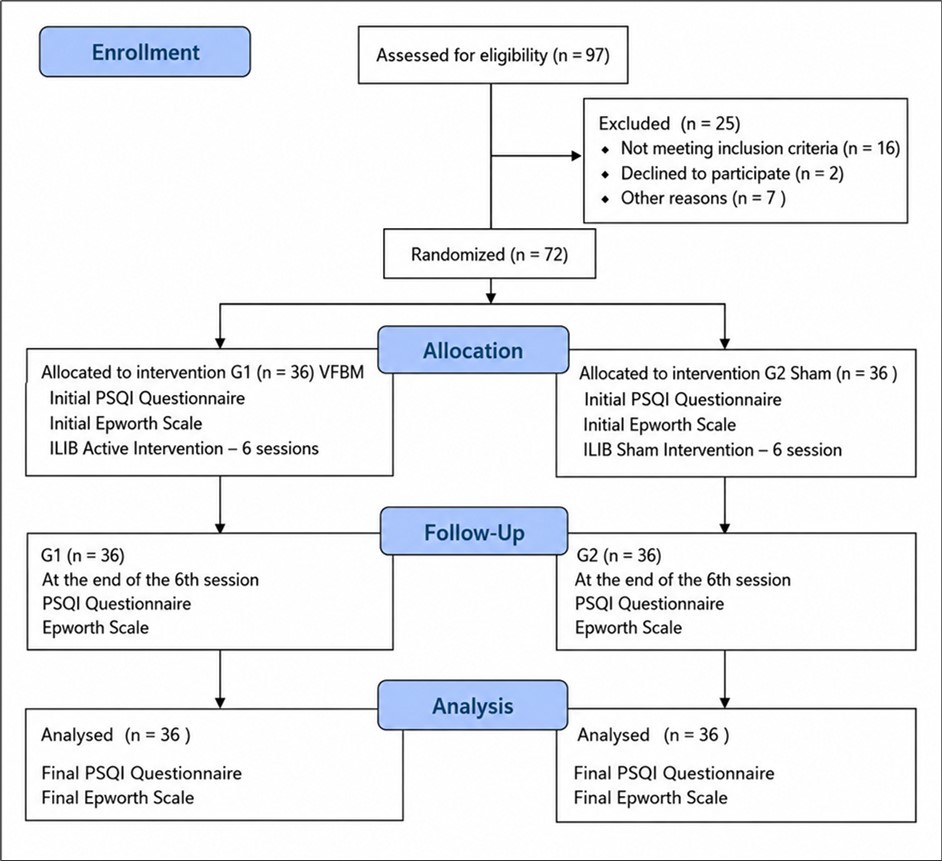
CONSORT Flow Diagram
Results
Between June 2022 and September 2022, 97 participants were identified for eligibility, and 72 were randomized to receive Modified Intravascular Laser Irradiation of Blood (ILIB) (n = 36) or Modified Intravascular Laser Irradiation of Blood Sham (n = 36). A total of 67 participants completed the study and had their data analyzed. 5 participants who did not complete the study had 5 absences, attending only the first session and not completing the 6 sessions stipulated for our study, so their data were not analyzed.
Epworth Sleepiness Scale (ESS)
The distribution of ESS scores are visually differentiated according to the control and treatment groups, but between the moments before and after intervention they appear similar (Figure 1).
Figure 1. Boxplot diagram of the distribution of Epworth Sleepiness Scale (ESS) scores among the studied groups at two time points, before and after the intervention.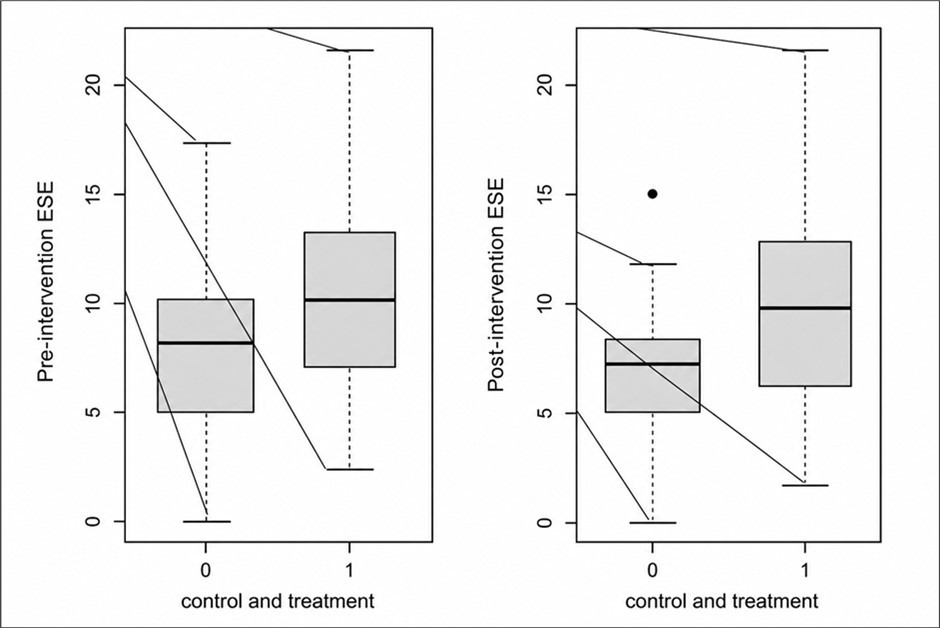
Download figure
The ESS scores were compared using the paired Wilcoxon test within each group, treatment and control. The distributions showed no differences between the moments, before and after intervention within each group (Table 2).
Table 2. Descriptive statistics and comparison of Epworth Sleepiness Scale (ESS) scores at two time points, within the treatment and control groups.| Mean (SD) | Median | 1st Quartile | 3rd Quartile | p-value ¹ | |
| Treatment | |||||
| Pre | 10,44 (4,59) | 10,00 | 7,00 | 12,75 | 0,277 |
| Post | 10,12 (4,36) | 10,00 | 7,25 | 12,75 | |
| Control | |||||
| Pre | 7,51 (4,04) | 8,00 | 5,00 | 10,00 | 0,482 |
| Post | 7,48 (3,06) | 8,00 | 6,00 | 9,00 | |
| Paired Wilcoxon test | |||||
When the comparison was made within each moment of the research, the ESS scores showed a non-significant change from 10.44 to 10.12. (Table 3).
Table 3. Descriptive statistics and comparison of the treatment and control groups for the Epworth Sleepiness Scale (ESS) scores at the two time points of the study.| Mean (SD) | Median | 1st Quartile | 3rd Quartile | p-value ¹ | |
| Pre | |||||
| Treatment | 10,44 (4,59) | 10,00 | 7,00 | 12,75 | <0,001 |
| Control | 7,51 (4,04) | 8,00 | 5,00 | 10,00 | |
| Post | |||||
| Treatment | 10,12 (4,36) | 10,00 | 7,25 | 12,75 | <0,001 |
| Control | 7,48 (3,06) | 8,00 | 6,00 | 9,00 | |
| Paired Wilcoxon test | |||||
Pittsburgh Sleep Quality Index (PSQI)
Figure 2 presents the boxplot for the PSQI scale scores, at the two moments of the research, before and after intervention. It is observed that the distributions are visually different between groups and treatments.
Figure 2. Boxplot diagram of the distribution of Pittsburgh Sleep Quality Index (PSQI) scores among the studied groups at two time points, before and after the intervention.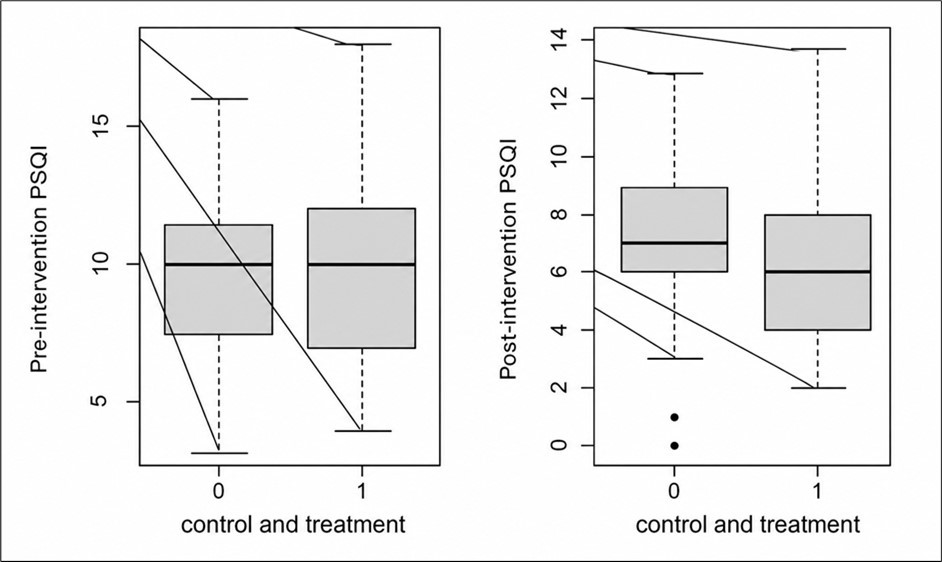
Download figure
Table 4 presents the paired comparison between the moments within the treatment and control groups. The scores of the Sleep Quality Scale (PSQI) showed statistically significant differences between the moments, pre- and post-treatment, being higher in both groups for the pre-intervention moment (Table 4).
Table 4. Descriptive statistics and comparison of Pittsburgh Sleep Quality Index (PSQI) scores at two time points, within the treatment and control groups.| Mean (SD) | Median | 1st Quartile | 3rd Quartile | p-value ¹ | |
| Treatment | |||||
| Pre | 10,24 (3,70) | 10,00 | 7,25 | 12,00 | < 0,001 |
| Post | 6,47 (2,87) | 6,00 | 4,25 | 7,75 | |
| Control | |||||
| Pre | 9,38 (3,44) | 10,00 | 7,75 | 11,25 | < 0,001 |
| Post | 7,18 (3,06) | 7,00 | 6,00 | 9,00 | |
| Paired Wilcoxon test | |||||
Table 5 presents the comparison within each moment, and it can be observed that the treatment and control groups have different values from a statistical point of view (significant) within each moment of the study. The highest scores are for the treatment group before the intervention and for the control group after the intervention.
Table 5. Descriptive statistics and comparison of the treatment and control groups for the Pittsburgh Sleep Quality Index (PSQI) scores at the two time points of the study.| Mean (SD) | Median | 1st Quartile | 3rd Quartile | p-value ¹ | |
| Pre | |||||
| Treatment | 10,24 (3,70) | 10,00 | 7,25 | 12,00 | < 0,001 |
| Control | 9,38 (3,44) | 10,00 | 7,75 | 11,25 | |
| Post | |||||
| Treatment | 6,47 (2,87) | 6,00 | 4,25 | 7,75 | <0,001 |
| Control | 7,18 (3,06) | 7,00 | 6,00 | 9,00 | |
| Paired Wilcoxon test | |||||
Mixed Models – PSQI
Table 8 presents the results of the analysis by mixed models for the Sleep Quality Scale (PSQI). The first model adjusted only the intercept and considers only the variation in the scale in the absence of predictors, showing that the average of the scale increases among the subjects of the study and that this average is significantly different from zero for all individuals (p<0.001). The random components, variances within the group (subjects random effects) and between individuals (residuals effects) are significant, which indicates that the variables referring to the moments (before and after treatment and groups (intervention and control) deserve to be tested. In this way, predictor variables can be included in the model to explain the variation of the PSQI scale (in the subjects and between the subjects).
In Table 6, model 2 considered the groups (control and intervention), and it is observed that the effect of the group was not significant. When the moment variable is included in the model, it is observed that there is a tendency to decrease in the average of the scale, and this decrease was statistically significant (model 3) when moving from the pre- to the post-intervention moment. At this moment, the interaction between groups and moments was tested (model 4), and it was statistically significant, showing that the scores of the treatment/intervention group and of the moment after the treatment showed a statistically significant decrease (β group and time point interaction = - 1.53 and p=0.021).
Table 6. Mixed models considering subjects, groups, and time points to explain Sleep Quality (PSQI) scores.| Model 1 | Model 2 | Model 3 | Model 4 | ||||||||
| Fixed effects | Estimate | SE | p value | Estimate | SE | p value | Estimate | SE | p value | Estimate | SE |
|---|---|---|---|---|---|---|---|---|---|---|---|
| Intercept | 8.31 | 0.37 | <0.001 | 8.19 | 0.52 | <0.001 | 9.71 | 0.55 | <0.001 | 9.31 | 0.57 |
| Group | 0.23 | 0.73 | 0.751 | 0.21 | 0.73 | 0.770 | 0.99 | 0.80 | |||
| Pre and post | -2.99 | 0.34 | <0.05 | -2.21 | 0.46 | ||||||
| Group and time point interaction | -1.53 | 0.65 | |||||||||
| Random effects | Variance Estimate | SD | Variance Estimate | SD | Variance Estimate | SD | Variance Estimate | SD | |||
| Subjects (intercept) | 4.69 | 2.17 | 4.68 | 2.16 | 6.85 | 2.62 | 7.03 | 2.65 | |||
| Residuals | 8.29 | 2.88 | 8.29 | 2.88 | 3.82 | 1.95 | 3.51 | 1.88 | |||
| AIC | 704,5 | 706,4 | 657,4 | 654,1 |
Thus, the best model, which best explains the scores of the PSQI scale, the most significant to be considered is model 4, as the random components of the residuals are smaller (and the AIC value as well) when compared with models 1, 2 and 3, showing that the scale presents different behavior (average) for the moments and for the interaction groups and moments. The residuals were normally distributed and without trend (Figure 3).
Figure 3. Residual plot of Model 4.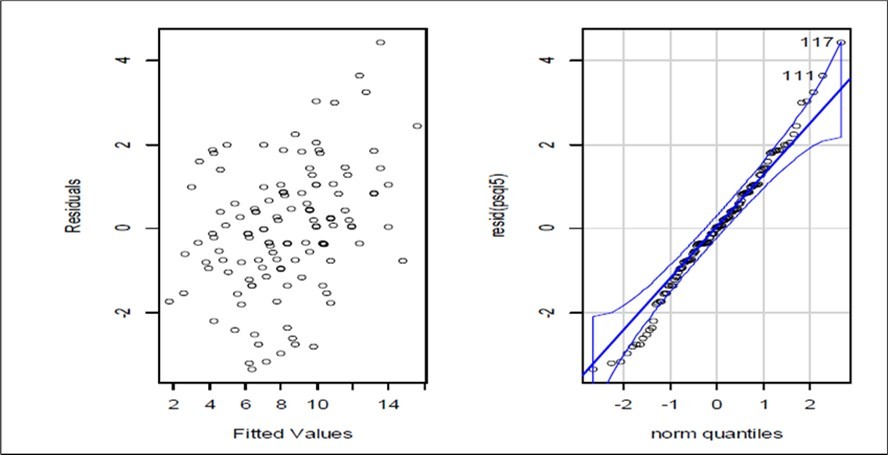
Download figure
· No serious adverse events were reported in either group.
· No complications attributable to the active or Sham devices were observed.
Discussion
Due to the number of patients affected with sleep disorders added to the costs and side effects of medications, it is extremely necessary to find new therapeutic approaches or alternative treatments that present good results, greater ease of use, good patient acceptance, all with lower cost and reduced side effects. Thus, the Modified Intravascular Laser Irradiation of Blood (ILIB) technique emerges as a promising approach. In the present study, we investigated whether Modified Intravascular Laser Irradiation of Blood (ILIB) would influence the sleep quality of patients with compromised sleep, through a randomized controlled clinical trial.
The present study is pioneering in the evaluation of the use of Vascular Photobiomodulation FBMV specifically on sleep quality as a complementary treatment, following rigorous methodology in relation to patient selection, randomization of groups, confidentiality of active or placebo group allocation, masking of application, and control of losses.
Positive results after evaluating the scores of the study variables may suggest that, in a systemic way through the application of FBM, we can observe effects already described for local photobiomodulation.
This effect of the therapy observed on sleep quality also seems to be related to effects of ILIB such as antioxidant, immunological, and hormonal action with direct reflections on the quality of life and sleep regulation, as researchers cite that the equipment that performs Modified Intravascular Laser Irradiation of Blood (ILIB) emits a luminous energy that activates the regulation and neuro-humoral synchronization and cellular modulation with antioxidant, metabolic, immunological, antispasmodic, sedative, healing, analgesic, anti-inflammatory effects, and increased blood circulation. It has a central effect stimulating the limbic system and hypothalamus, as well as a hormonal effect regulating sleep, mood, and normalizing endorphins and serotonin, generating well-being and improving quality of life 27, 16, 28, 17, 29, 30, 31.
Our results showed that treatment with ILIB promoted improvement in the scores evaluated on the Epworth Sleepiness Scale (ESS) and on the Pittsburgh Sleep Quality Index (PSQI). This result leads us to suggest that ILIB modulates the homeostasis of the organism through its systemic action. The literature points out that the mechanism of action of FBM is based on the absorption of photons by cellular chromophores, the most described being the enzyme cytochrome c oxidase, which is part of the mitochondrial respiratory chain. The absorption of energy delivered by light sources initially generates an increase in ATP production and electron transport, which will lead to the activation of many signaling pathways that will subsequently activate transcription factors related to the production of key proteins in the regulation of cellular metabolism and the inflammatory response. 32
A recent pilot study investigating the effects of Intravenous Laser Irradiation of Blood (ILIB) in long COVID patients with persistent neurological symptoms provides valuable insight into the broader therapeutic potential of ILIB, particularly regarding sleep quality. In this study, patients underwent a series of 30 ILIB sessions, resulting in significant improvements in both cognitive function and sleep quality, as evidenced by enhanced scores on the Montreal Cognitive Assessment (MoCA) and the Athens Insomnia Scale (AIS) post-treatment. These clinical outcomes were paralleled by molecular findings, including upregulation of mitochondrial electron transport and oxidative phosphorylation pathways, alongside downregulation of immune and inflammatory responses. Notably, modulation of the glutathione metabolism pathway suggested a reduction in oxidative stress, a mechanism closely linked to sleep regulation and neuroprotection. The observed amelioration of insomnia symptoms in this cohort supports the hypothesis that ILIB may exert beneficial effects on sleep quality through the attenuation of neuroinflammation and oxidative imbalance. These findings align with the objectives of the present study, reinforcing the rationale for exploring ILIB as a non-pharmacological intervention to improve sleep quality, and underscore the need for further research in larger, controlled populations to validate these preliminary results. 33
The systemic physiological effects of ILIB, such as reduced oxidative stress and improved microcirculation, may directly influence the neural circuits of sleep-wake regulation. Specifically, enhanced metabolic homeostasis might modulate the activity of the ventrolateral preoptic area (VLPO)—a key sleep-promoting nucleus—or the ascending reticular activating system (ARAS). The complex, systemic nature of sleep regulation necessitates therapeutic approaches that target multiple physiological pathways, akin to the multifactorial engineering solutions required in other complex systems 34.
The observed improvement in sleep quality may be related to ILIB’s documented antioxidant, immunological, and hormonal effects, with direct reflections on the quality of life and sleep regulation.
The results from this sample suggest that ILIB may provide benefits for sleep, particularly regarding sleep time per night and the quality of rest
Considering that this study is pioneering in the use of Modified Intravascular Laser Irradiation of Blood (ILIB) specifically for the treatment of sleep quality, the data are interesting and promote the stimulation of future investigations, mainly in relation to the mechanisms involved, better dosimetry and application time, in addition to the possibility of conducting studies with greater investment in marker analysis and the use of polysomnography.
The sample size of this study allows us to understand that Modified Intravascular Laser Irradiation of Blood (ILIB) seems to present benefits for the sleep of patients, in relation to sleep time per night, quality of rest after sleep, tiredness during the day, difficulty waking up or falling asleep, and score on the questionnaires. It is a cost-effective equipment, simple application technique, and accessible for use in the hospital, clinical, and domestic environment, and does not require complex structure and prerequisites for its handling.
Limitations
This study has limitations that should be considered. First, it relied solely on subjective self-report measures (PSQI and ESS); while validated, these do not provide the objective physiological data offered by polysomnography or actigraphy. Second, the relatively short-term nature of the intervention and follow-up leaves the long-term durability of the treatment effects unknown. Finally, the sample consisted of adults with self-reported poor sleep, which may limit the generalizability of the findings to clinical populations with diagnosed insomnia disorders or severe comorbidities.
Conclusion
The results of the present randomized clinical trial showed that the use of Modified Intravascular Laser Irradiation of Blood (ILIB) can be presented as a therapeutic alternative for compromised sleep. Through the results, it was possible to observe positive effects on sleep quality, sleep latency, and control of daytime sleepiness demonstrated through a significant decrease in the scores of the PSQI questionnaires. Thus, we can conclude that Modified Intravascular Laser Irradiation of Blood (ILIB) is a safe technique and that it emerges as a therapeutic possibility for contributing to sleep quality, the data are promising and promote the stimulation of future investigations, mainly in relation to the mechanisms involved, better dosimetry and application time, in addition to the possibility of conducting studies with greater investment in biomarker analysis and the use of polysomnography.
References
- 2.R E B, BASHEER R, J T MCKENNA, R E ST, R W MCCA. (2012) Control of sleep and wakefulness. , Physiol. Rev 92-1087.
- 5.ALÓE F, AZEVEDO A, HASAN R. (2005) Sleep-wake cycle mechanisms.Brazilian. , maio, Journal of Psychiatry 27.
- 6.SMGP TOGEIRO, SMITH A K. (2005) Métodos diagnósticos nos distúrbios do sono. Rev Bras Psiquiatr. 27(Supl I): 8-15.
- 7.BUYSSE D J, REYNOLDS C F, MONK T H, BERMAN S R, KUPFER D J. (1989) The Pittsburgh Sleep Quality Index: a new instrument for psychiatric practice and research. Psychiatry Res. 28, 193-213.
- 8.BERTOLAZI A N, FAGONDES S C, HOFF L S, DARTORA E G, MIOZZO I C et al. (2011) Validation of the brazilian portuguese version of the Pittsburgh Sleep Quality Index. Sleep Med. 12(1), 70-5.
- 9.T I KARU.Cellular and Molecular Mechanisms of Photobiomodulation (Low-Power Laser Therapy). , IEEE Journal of Selected Topics in Quantum Electronics 20(2), 143-148.
- 10.ZHANG J, XING D, GAO X.Low-power laser irradiation activates Src tyrosine kinase through reactive oxygen species-mediated signaling pathway. , J Cell Physiol 217(2), 518-28.
- 13.M R HA.Mechanisms and applications of the anti-inflammatory effects of photobiomodulation. , AIMS Biophys 4(3), 337-361.
- 14.SLEEP MEDICINE RESEARCH. (2024) Photobiomodulation and its therapeutic potential in sleep.Sleep Med Res.
- 15.RODRÍGUEZ-FERNÁNDEZ L, ZORZO C, ARIAS J. (2024) Photobiomodulation in the aging brain: a systematic review from animal models to humans.Geroscience, v. p..
- 16.P Y WU. (2018) Effects of intravenous laser irradiation of blood on pain, function and depression of fibromyalgia patients. , Gen. Med., Los Angeles, V 6, 10-4172.
- 17.V A MIKHAYLO. (2015) The use of Intravenous Laser Blood Irradiation (ILBI) at 630-640 nm to prevent vascular diseases and to increase life expectancy. Laser Ther. 24(1), 15-26.
- 18.DA SILVA LEAL, V M.Effect of modified laser transcutaneous irradiation on pain and quality of life in patients with diabetic neuropathy. Photobiomodulation, Photomedicine and Laser Surgery, V.38, N.3 138-144.
- 19.BRASSOLATTI P. (2025) Systemic photobiomodulation: an integrative review of evidence for intravascular laser irradiation of blood and vascular photobiomodulation.Lasers. in Medical Science, v. n. p .
- 20.DOS SANTOS MALAVAZZI, C T. (2023) Effects of the invasive and non-invasive systemic photobiomodulation using low-level laser in experimental models: a systematic review.Lasers. in Medical Science, v. p .
- 21.TOMÉ R F F. (2020) Ilib (intravascular laser irradiation of blood) as an adjuvant therapy in the treatment of patients with chronic systemic diseases-an integrative literature review. , Lasers in Medical Science 35, 1899-1907.
- 22.KENNEDY K E R. (2023) A randomized, sham-controlled trial of a novel near-infrared phototherapy device on sleep and daytime function.Journal of Clinical Sleep Medicine. , v. p
- 23.ZHAO X. (2022) Brain photobiomodulation improves sleep quality in subjective cognitive decline: a randomized, sham-controlled study.Journal of Alzheimer’s Disease. v, p..
- 24.LIN M-Y. (2025) Effects of photobiomodulation on the sleep quality and quality of life of night-shift nurses.Lasers. in Medical Science, v. p .
- 25.P Y WU. (2024) Vascular photobiomodulation for post-COVID-19 headache and orofacial pain: randomized clinical trial.Scientific Reports.
- 26.Y L CHANG, S T CHANG. (2022) Effects of intravascular photobiomodulation on sleep disturbance caused by Guillain-Barré syndrome after Astrazeneca vaccine inoculation: case report and literature review.Medicine. , (Baltimore), v. e28758
- 27.ISABELLA A P J. (2019) Effect of irradiation with intravascular laser on the hemodynamic variables of hypertensive patients: study protocol for prospective blinded randomized clinical trial. , Medicine, Baltimore, V. 98, N 14, 10-1097.
- 28.K et. (2013) al.A metabolomic study on the effect of intravascular laser blood irradiation on type 2 diabetic patients. , Lasers Med. Sci., London, V 28, 1527-32.
- 29.MOMENZADEH S.The intravenous laser blood irradiation in chronic pain and fibromyalgia. , J Lasers Med Sci 6(1), 6-9.
- 30.Huang S F, Tsai Y A, Wu S B, Wei Y H, Tsai P Y et al. (2012) Effects of intravascular laser irradiation of blood in mitochondria dysfunction and oxidative stress in adults with chronic spinal cord injury. Photomed Laser Surg. 30(10), 579-86.
- 31.M H WEBER, T W Fussgänger-May. (2007) Intravenous laser blood irradiation. , German J. Acupunct. Rel. Tech 50, 12-23.
- 32.HAMBLIN M R.Shining light on the head: Photobiomodulation for brain disorders. , BBA Clin 2016, 113-124.
- 33.CHANG C C, LI Y H, CHANG S T, CHEN H H. (2025) . Impact of Intravenous Laser Irradiation of Blood on Cognitive Function and Molecular Pathways in Long COVID Patients: A 10-1093.
- 34.KIANOUSH P. (2024) Investigating the effect of hole size, bottom hole temperature, and composition on cement bonding quality of exploratory wells in Iran. Scientific Reports. 14(1), 29653-10.
- 35.BERTOLAZI A N, FAGONDES S C, HOFF L S, PEDRO V D, MENNA BARRETO SS et al. (2009) Portuguese-language version of the Epworth Sleepiness Scale: validation for use in. , English, Portuguese. DOI: 35(9), 877-83.
- 36.M R HA, FERRARESI C, HUANG Y Y, FREITAS L F, CARROLL J. (2018) Low-level light therapy : photobiomodulation. , Washington USA: 367.
- 37.BUYSSE D J, REYNOLDS C F, MONK T H, BERMAN S R, KUPFER D J.The pittsburgh sleep quality index: a new instrument for psychiatric practice and research. Psychiatry Res. 28(2), 193-213.
- 38.JOHNS M W.A new method for measuring daytime sleepiness: the epworth sleepiness scale. , sleep 14(6), 540-5.
- 39.JOHNS M W.Sensitivity and specificity of the multiple sleep latency test (mslt), the maintenance of wakefulness test and the epworth sleepiness scale: failure of the mslt as a gold standard. , J Sleep Res 9(1), 5-11.
- 40.CHANG Y L, CHANG S T. (2022) The effects of intravascular photobiomodulation on sleep disturbance caused by guillain-barré syndrome after astrazeneca vaccine inoculation: case report and literature review. Medicine (Baltimore). 11;101(6):E28758. DOI: 10.1097/MD.0000000000028758. PMID: 35147100; PMCID: PMC8830854 .