Influence of Non-Contact-Based Spiritual Blessing Energy Treatment on Growth Metrics and Reproductive Productivity in Okra (Abelmoschus esculentus L.)
Abstract
This study investigated the influence of a non-contact based spiritual blessing energy treatment (SBET) on the growth dynamics and reproductive productivity of okra (Abelmoschus esculentus L.). Utilizing a Randomized Complete Block Design, okra seeds and farming land were divided into treated and untreated cohorts under identical environmental conditions. The treated cohort received spiritual thought-intention-based energetic blessings, while the control group received none (untreated). Both qualitative and quantitative analysis revealed significant enhancements in the treatment group across multiple agronomic indices. Phenological parameters such as plant height, stem collar diameter, number of branches per plant, number of leaves per plant, fruit weight, fruit length, and fruit diameter were significantly increased by 29.57% (p ≤ 0.001), 45.83% (p ≤ 0.001), 40.49% (p = 0.006), 41.61% (p ≤ 0.001), 47.61% (p ≤ 0.001), 40.26% (p ≤ 0.001), and 37.58% (p ≤ 0.001), respectively, in the treatment group compared to the control group. Further, fruits yield (tons per hectare) was rose by 38.25% in the treatment group compared to the control. These findings suggest that subtle, thought-intention-based spiritual blessing energy treatment may interact positively with plant biophysical pathways, modifying cellular or metabolic efficiency and improved vegetative growth and yields of okra.
Article Information
- Received
- Accepted
- Published
Academic Editor: Anubha Bajaj, Consultant Histopathologist, A.B. Diagnostics, Delhi, India
Checked for plagiarism: Yes
Review by: Single-blind
Copyright © 2026 Mahendra Kumar Trivedi, et al.
 This is an open-access article distributed under the terms of the Creative Commons Attribution License, which permits unrestricted use, distribution, and reproduction in any medium, provided the original author and source are credited.
Corresponding author: Snehasis Jana, Trivedi Science Research Laboratory, Pvt, Ltd., Research and Development, Thane (W), Maharashtra, India —
Competing Interests
Author MKT was employed by Trivedi Global, Inc. NRP, TBG, and VDK were employed by Shree Angarsiddha Shikshan Prasarak Mandal’s College of Agriculture, Sangulwadi, Mohitewadi, Maharashtra, India.Authors SM and SJ were employed by Trivedi Science Research Laboratory Pvt. Ltd.
Funding
The authors declare that no funds, grants, or other support were received during the preparation of this manuscript.
Data Availability
No data-availability statement was provided by the authors.
Acknowledgements
The authors are grateful to Divine Connection Foundation for the assistance and support during the work.
Citation:
Introduction
Okra (Abelmoschus esculentus L.), belonging to the Malvaceae family, was a highly valuable annual vegetable crop extensively cultivated across tropical, subtropical, and warm temperate regions, including India. It plays an essential role in human nutrition due to its high dietary fiber content, essential macro- and micro-elements, antioxidant compounds, and vitamins 1. Global agricultural systems are currently facing severe, unprecedented challenges driven by shifting climatic patterns, freshwater scarcity, and the progressive degradation of arable land 2. These environmental anomalies compromise the physiological stability, phenotypic expression, and overall productivity of economically vital crops. To sustain food security for an expanding global population, modern agronomy has heavily relied on synthetic agrochemicals, such as chemical fertilizers and artificial plant growth regulators 3. While these conventional interventions have successfully maximized localized crop yields, their continuous and intensive application raises critical concerns. These includes the degradation of soil microbial functional diversity, the disruption of subterranean biogeochemical cycling, and widespread environmental toxicity 3. Consequently, there is an urgent and growing imperative within the scientific community to discover innovative, non-toxic, and sustainable "Green Technologies" capable of optimizing plant vigor and reproductive output without introducing chemical residues into the biosphere.
Researchers are actively exploring technologies that can modulate physiological and biochemical processes within plant tissues using alternative energetic mechanisms 4, 5. Traditional physical seed treatments, such as exposing seeds or seedlings to low-frequency magnetic fields, electric field energy, acoustic vibrations, and laser irradiation—have been shown to induce significant metabolic variations. These external energetic inputs alter biological processes by exciting protein activities, accelerating enzymatic reactions, and improving seed vigor parameters like germination speed and uniformity 4. Beyond these mechanical and electromagnetic interventions, subtle energy fields and human consciousness therapies have emerged as compelling areas of academic inquiry. The National Center for Complementary and Integrative Health (NCCIH) categorizes these subtle modalities as Biofield Energy Treatments, defining them as alternative healthcare and biological strategies that manipulate dynamic, low-level energy fields surrounding living organisms 6, 7, 8, 9. When applied to botanical subjects, these subtle biofields and deliberate human intentions have demonstrated a unique capacity to alter macro- and micro-level systems. This includes modifying cellular processes and accelerating early metabolic responses without direct physical contact or conventional chemical triggers 10.
Nevertheless, comprehensive scientific documentation evaluating how non-contact spiritual blessing energy impacts the full lifecycle of okra, ranging from detailed vegetative growth profiles to final reproductive productivity metrics, remains scarce in peer-reviewed agronomic literature. To address this gap in knowledge, this study investigated the systematic application of a non-contact, intention-based Spiritual Blessing (Biofield) Energy Treatment (SBET) on Abelmoschus esculentus L. The objective was to determine whether this subtle biophysical blessing intervention can positively influence phenological development, vegetative biomass accumulation, and reproductive yield characteristics. By evaluating these morphological and reproductive indicators under standard experimental parameters, this research aimed to provide a robust, scientifically grounded framework for incorporating blessing/biofield energy treatment concepts into sustainable quantum agricultural models.
Materials and Methods
Study site details
The field experiment was conducted at Bhandarwadi, situated in the Sindhudurg district of Maharashtra, India 15°37’–16°40’ N, 73°19’–74°13’ E; 26 m above mean sea level). Located within the Konkan agro-climatic zone, the experimental site experiences a tropical climate characterized by mean maximum temperatures ranging from 40–42°C during the pre-monsoon season. Pronounced interannual rainfall variability in this region frequently induces acute soil moisture deficits, thereby intensifying crop susceptibility to water stress and potentially compromising critical physiological processes across key phenological stages.
Seed details and experimental design
Okra (Abelmoschus esculentus L. Moench, cv. 'Jenifer') seeds characterized by a 95% genetic purity baseline (Lot No. NUA-54012353; Label: 17387) were sourced from Namdeo Umaji Agritech (India) Pvt. Ltd. The seed stock was systematically partitioned into two distinct experimental cohorts: an untreated control group (CONOKG) and a biofield energy-treated group (BTOKG), the latter of which was subjected to a Spiritual Blessing Energy Treatment (SBET). To isolate the specific effects of the SBET intervention and eliminate potentially confounding variables, all agronomic and environmental parameters, including irrigation scheduling, fertilization regimens, and pest management protocols, were kept strictly uniform across both experimental groups for the entire duration of the study.
Field layout
The experiment was arranged in a Randomized Complete Block Design (RCBD) with two treatments, control (CON) and biofield-treated (BT), replicated across three blocks. Each block comprised two experimental units (plots), to which the treatments were randomly assigned. The total experimental area spanned 50 m2 and consisted of six plots, each measuring 3.5 m x 2 m, individual plot area of 7.0 m2. Inter-plot and inter-block spacing were uniformly maintained at 0.5 m, with a plant-to-plant spacing of 0.5 m x 0.5 m. Prior to sowing, the experimental site was cleared of debris, and standard baseline fertilizers were incorporated into the soil of each plot at a rate of 50:100:50 kg NPK/ha.
Spiritual blessing (prayer) energy treatment strategy
A randomized comparative study was conducted using a control group (CONOKG), consisting of untreated okra seeds and soil matrices, and an experimental blessing treatment group (BTOKG). The BTOKG samples were subjected to a 4-minute external spiritual blessing (biofield) energy administered by a renowned practitioner (more than 17 years practiced) Mr. Mahendra Kumar Trivedi with from a non-contact distance of approximately 0.5 m to eliminate physical confounding variables. Ambient environmental conditions during the protocol were maintained at a temperature of 28 ± 2°C and a relative humidity of 65 ± 5%. Following the intervention, both control and treated matrices were cultivated under identical, standardized agronomic conditions. Phenotypic characteristics and physiological variations were systematically monitored to evaluate the efficacy of the biofield treatment on the agricultural matrix.
Soil properties
Baseline soil characterization was conducted on composite samples collected from the upper 30 cm of each plot using a five-point sampling design. Post-collection, samples were air-dried, passed through a 2-mm sieve to ensure homogeneity, and stored at 4 °C prior to analysis. Soil texture (particle size distribution) was qualitatively assessed according to established protocols 11. Potentiometric pH was determined in a 1:2 (w/v) soil-to-distilled water suspension using a calibrated electronic pH meter.
Seed plantation and management
Following direct sowing, the experimental plots were manually irrigated for 7 days prior to transitioning to a drip irrigation system equipped with pressure-compensating emitters (0.5-m spacing; flow rate of 3 L/h). Fertilizer was applied at a baseline rate of 50:100:50 kg/ha of nitrogen (N), phosphorus (P), and potassium (K), respectively. The full doses of phosphorus administered as single superphosphate (SSP) and potassium was administered as muriate of potash (MOP) along with 50% of the total nitrogen (as urea) were applied pre-sowing. The remaining 50% of nitrogen was side-dressed at 21 days after sowing (DAS). Insect pest management was standardized across all experimental treatments via a foliar application of a combination insecticide containing 50% chlorpyrifos and 5% cypermethrin (Hamla 550, Gharda Chemicals Ltd., Mumbai, India) at a concentration of 2 mL/L.
Plant growth parameters
Five plants per plot were randomly sampled at seventy-two days after sowing (DAS) for phenotypic characterization. Agromorphological traits were evaluated using both qualitative and quantitative descriptors. Qualitative attributes assessed in situ included plant growth habit, branching pattern, canopy architecture, stem pigmentation, leaf margin dentation, lobing depth, venation color, foliar color, leaf blade width, leaf blade lobing, leaf blade apex angle, leaf prickliness, leaf pubescence, floral color, floral size, flower bud color, immature fruit color, fruit shape, fruit apex shape, seed color, seed size, and seediness. Quantitative data were recorded for plant height (cm), number of branches per plant, stem diameter (cm), days to 50% flowering, fruit length (cm), and fruit diameter (cm).
Yield parameters
Okra (Abelmoschus esculentus) fruits were harvested at physiological maturity. Allometric traits, including fruit length and diameter, were quantified using digital calipers, while individual fruit mass was measured using a precision electronic balance. To evaluate cumulative productivity, five plants per net plot were selected via simple random sampling. Total fruit yield per plot was recorded in kilograms and standardly extrapolated to metric tonnes per hectare (t/ha).
Data analysis
Quantitative data are expressed as mean ± standard error of the mean (SEM). Intergroup differences between the two independent cohorts were evaluated using a two-tailed Student’s t-test. All statistical analyses were performed using SigmaPlot (version 14.0), with statistical significance defined as p < 0.05.
Results
Soil properties analysis
Edaphic analysis initially characterized the soil as a strongly acidic (pH 5.01) sandy loam with restricted nutrient mobility and limited cation exchange capacity (CEC). Post-harvest results demonstrated that SBET application significantly neutralized the soil, raising the pH to 5.86. This neutralization concurrently increased exchangeable cations (Ca2+, Mg2+, and Na+) and total K in the BTOKG cohort compared to the CONOKG. Consequently, these data implied that the blessing intervention modified ion exchange dynamics and mineral solubility, presenting a strategic mechanism to mitigate constraints inherent to acidic soil profiles.
Morphology of okra plants
We documented the morphological characteristics of okra (Abelmoschus esculentus) through systematic observations at defined intervals. The study tracked the complete phenological progression, from initial germination and the seedling phase through vegetative growth, floral initiation, fruit development, and the final harvest stage (Figure 1).
Figure 1. Representative images illustrated the changes in vegetative growth characteristics of okra at different stages. C: Control group; BET: Blessing/biofield energy treatment group.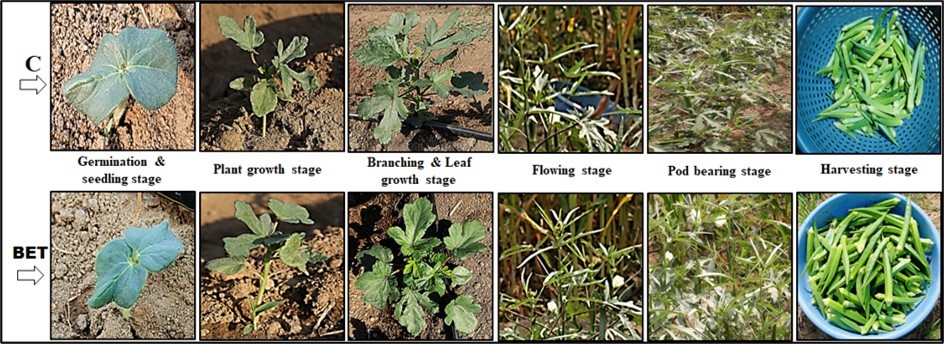
Download figure
Morphological attributes
A very broad plant spread area was observed in the BTOKG, and the CONOKG was broad. Plant branching was intermediate for CONOKG and strong for BTOKG. In the treatment group (BTOKG), dark green-coloured stems and leaves were observed, whereas green stems and leaves were observed in CONOKG. Dentation of leaf margin was medium in CONOKG and strong in BTOKG. BTOKG and CONOKG had deep and medium depth of leaf lobbing, respectively. The CONOKG showed greenish violet and BTOKG showed dark violet pigmentation. Wide leaf blade width was observed in BTOKG and narrow in the CONOKG. Leaf blade lobing was strong in BTOKG and intermediate in the CONOKG. The leaf blade tip angle was acute for CONOKG, whereas an obtuse tip angle was found in BTOKG. Leaf prickle was found intermediate in BTOKG, while few in the CONOKG. CONOKG had light greenish purple vein colour, and the BTOKG had purple green vein colour. Intensity of colour between veins was medium green in CONOKG and dark green in BTOKG. Leaf hairs were many (>100) in the BTOKG and few (<50) hairs found in CONOKG. The flower colour of CONOKG was pale yellow crimson, whereas yellow crimson was observed in BTOKG. The colour of the okra fruit was dark green in the BTOKG group, and CONOKG had green fruits. The CONOKG group had greenish brown seed colour, and the BTOKG had brown seed colour. Seed size was intermediate in BTOKG, while small in case of CONOKG. The number of seeds per fruit (known as seediness) was medium (<30) in CONOKG, and high (>50) in BTOKG (Table 1). Other morphological parameters such as plant growth habit, flower size, flower bud colour, flower bud size, and fruit shape apex were unaltered after SBET.
Table 1. Effects of spiritual blessing (biofield) energy treatment (SBET) on qualitative vegetative parameters of okra.| Vegetative Trait | Control Group (CONOKG) | Treated Group (BTOKG) |
| Plant growth habit | Upright | Upright |
| Plant spread | Broad (>45 cm) | Very broad (>60 cm) |
| Plant branching | Intermediate (3-5) | Strong (>5) |
| Stem color | Green | Dark green |
| Dentation of leaf margin | Medium | Strong |
| Depth of lobbing | Medium | Deep |
| Pigmentation | Greenish violet | Dark violet |
| Leaf color | Green | Dark green |
| Leaf vein color | Light greenish purple | Purple green |
| Color between veins | Medium green | Dark green |
| Leaf blade width | Narrow (< 5 cm) | Wide (>10 cm) |
| Leaf blade lobing | Intermediate (<5) | Strong (>7) |
| Leaf blade tip angle | Acute (3) | Obtuse (>7) |
| Leaf prickle | Few (3-5) | Intermediate (10-20) |
| Leaf hairs | Few (<50) | Many (>100) |
| Flower color | Pale yellow crimson | Yellow crimson |
| Flower size | Small | Small |
| Flower bud color | Purplish green | Purplish green |
| Flower bud size | Small | Small |
| Fruit shape apex | Narrow | Narrow |
| Fruit colour | Green | Dark green |
| Seed colour | Greenish brown | Brown |
| Seed size | Small (< 2 mm) | Intermediate (> 3 mm) |
| Seediness (number of seeds/ fruit) | Medium (<30) | High (> 50) |
Phenology and yield traits
The rate of germination and plant height were increased significantly by 14.91% (p ≤ 0.001) and 29.57% (p ≤ 0.001), respectively, in BTOKG compared to the control, CONOKG. Plant architecture such as stem collar diameter, number of branches per plant, and internodal length were significantly increased by 45.83% (p ≤ 0.001), 40.49% (p = 0.006), and 27.80% (p = 0.005), respectively, in the BTOKG compared to the control, CONOKG. Parameters related to photosynthetic capacity such as the number of leaves per plant, leaf length, leaf width, and peduncle length were rose by 41.61% (p ≤ 0.001), 22.75% (p ≤ 0.001), 20.52% (p ≤ 0.001), and 22.16% (p ≤ 0.001), respectively, in the BTOKG than CONOKG. Fruits-related parameters such as fruit pedicel length, fruit weight, fruit length, fruit diameter, fruit girth, number of fruit ridge, and 100-seed weight were significantly increased by 17.76% (p = 0.013), 47.61% (p ≤ 0.001), 40.26% (p ≤ 0.001), 37.58% (p ≤ 0.001), 25.37% (p = 0.004), 18.75% (p ≤ 0.001), and 28.31% (p ≤ 0.001), respectively, in the BTOKG with respect to the CONOKG. Furthermore, in the BTOKG fruits yield (tons per hectare) were rose by 38.25% compared to the CONOKG (Table 2).
Table 2. Quantitative evaluation of the phenological and yield characteristics of okra following spiritual (biofield/prayer) energy treatment.| Vegetative Trait | Control Group(CONOKG) | Treated Group(BTOKG) | P value |
| Days to germination | 5-7 | 5-6 | - |
| Germination percentage | 82.85 ± 0.16 | 95.20 ± 0.22 | p ≤ 0.001 |
| Plant height (cm) | 72.41 ± 1.57 | 93.82 ± 1.63 | p ≤ 0.001 |
| Stem collar diameter (cm) | 1.20 ± 0.03 | 1.75 ± 0.08 | p ≤ 0.001 |
| Number of branches per plant | 4.52 ± 0.16 | 6.35 ± 0.46 | p = 0.006 |
| Internodal length (cm) | 5.18 ± 0.11 | 6.62 ± 0.36 | p = 0.005 |
| Number of leaves per plant | 18.89 ± 0.64 | 26.75 ± 0.46 | p ≤ 0.001 |
| Leaf length (cm) | 14.11 ± 0.15 | 17.32 ± 0.21 | p ≤ 0.001 |
| Leaf width (cm) | 12.72 ± 0.17 | 15.33 ± 0.11 | p ≤ 0.001 |
| Peduncle length (cm) | 1.85 ± 0.03 | 2.26 ± 0.01 | p ≤ 0.001 |
| Days to first flowering | 42.34 ± 1.07 | 40.17 ± 1.32 | p = 0.237 |
| Days to 50% flowering | 51.25 ± 0.44 | 50.28 ± 0.31 | p = 0.109 |
| Days to first fruiting | 55.35 ± 1.26 | 53.61 ± 1.09 | p = 0.327 |
| Fruit pedicel length (cm) | 1.52 ± 0.03 | 1.79 ± 0.08 | p = 0.013 |
| Days to first harvest | 65.33 ± 1.62 | 65.72 ± 1.22 | p = 0.852 |
| Fruit weight (gm) | 8.36 ± 0.14 | 12.34 ± 0.23 | p ≤ 0.001 |
| Duration of crop (days) | 99.62 ± 1.68 | 98.57 ± 1.36 | p = 0.640 |
| Fruit length (cm) | 10.16 ± 0.12 | 14.25 ± 0.24 | p ≤ 0.001 |
| Fruit diameter (cm) | 1.57 ± 0.02 | 2.16 ± 0.03 | p ≤ 0.001 |
| Girth of fruit (cm) | 1.34 ± 0.05 | 1.68 ± 0.07 | p = 0.004 |
| Number of fruit ridge | 5.12 ± 0.05 | 6.08 ± 0.04 | p ≤ 0.001 |
| 100-seed weight (gm) | 5.37 ± 0.15 | 6.89 ± 0.12 | p ≤ 0.001 |
| Number of fruits per plant | 30.40 | 38.27 | - |
| Fruits yield per plant (kg/plant) | 0.29 | 0.38 | - |
| Total fruit yield (kg)/plot | 24.93 | 34.46 | - |
| Fruit yield/sq. m plot (kg/sq. m) | 1.19 | 1.64 | - |
| Fruit yield/hectare (t/ha) | 11.87 | 16.41 | - |
Discussion
The broad plant spread area and strong branching observed in BTOKG relative to the intermediate branching and broad spread of CONOKG point to an enhancement in the vegetative growth capacity. A well-branched architecture significantly expands the source capacity of the crop by increasing the number of active nodes capable of bearing fruits 12. Leaf shape was a vital agronomic trait that affects plant and canopy architecture, yield, and other production attributes of okra. Compared with normal leaves, lobed leaves have potential advantages in improving canopy structure and increasing the yield 13.In this experiment, a wide leaf blade width and strong leaf blade lobing with deep lobing depth seen in BTOKG, optimizing more light interception and photosynthetic efficiency. Chlorophyll levels were directly correlated with fruit fresh weight and overall biomass production in okra 14. In BTOKG, the shift from green stems and leaves in CONOKG to dark green coloured vegetative structures in BTOKG indicated a marked alteration in chlorophyll concentration and tissue development. Thus, this intense dark green coloration observed between the veins of BTOKG leaves mirrors these enhanced chlorophyll attributes.
Transcriptomic and metabolic analyses have established that distinct purple-red or dark violet colorations across okra stems, veins, and pods arise from the selective accumulation of specialized pigments like delphinidin 3-O-sambubioside and cyanidin 3-O-sambubioside 15.
Here, the transition from greenish-violet pigmentation and light greenish-purple veins in CONOKG to dark violet pigmentation and purple-green veins in BTOKG indicates a strong upregulation of anthocyanin biosynthetic pathways. These improvements of anthocyanin might be due to SBET (Trivedi Effect®). From Table 1, an increase in leaf hair, accompanied by an intermediate presence of leaf prickles in the BTOKG compared to the control. This elevated trichome (leaf hair) density alters the boundary-layer aerodynamics and optical properties of the leaf blade, serving an essential protective role. Dense non-glandular trichomes provide a critical physical barrier that reduces light stress and enhances absolute defense capabilities against insect herbivores 16. These physical structural barriers also modify basic light reflection patterns, indirectly protecting underlying photosynthetic machinery from radiation damage 17. The improvement of seediness per fruit in the BTOKG indicates enhanced fertilization efficiency. Variations in macro-morphological traits, particularly fruit shape, color, and seed development dynamics, represent direct phenotypic markers linked to geographical, environmental, or treatment-driven adaptation 18. The stability of traits such as growth habit, flower size, flower bud color, flower bud size, and fruit shape apex after SBET demonstrates that the intervention selectively targeted yield-contributing structural variables and pigment pathways without compromising the core botanical identity of the species.
The experimental results demonstrate that the notable increase in the germination rate alongside expansion in total plant height suggests an early developmental acceleration. Enhanced vegetative traits and accelerated emergence patterns are frequently tied to improved metabolic resource coordination during initial growth phases 19. There were substantial increases in stem collar diameter, branch accumulation per plant, and internodal elongation (Table 2). These structural modifications mirror phenotypic behaviors observed in optimized okra germplasm evaluations, where lateral branching and stem thickening serve as essential mechanical frameworks to support subsequent high reproductive loads 20. Key indicators of photosynthetic capacity, including total leaf number per plant, leaf length, leaf width, and peduncle extension, showed a remarkable increase in the BTOKG compared to the CONOKG. This broad vegetative canopy expansion implies an increased surface area for light interception and carbon assimilation. The optimization of leaf dimensions and total leaf numbers typically leads to higher localized carbohydrate synthesis, which provides the necessary carbon skeletons to drive downstream reproductive allocation [21]. Fruit morphogenesis and seed development showed distinct upgrades, as evidenced by significant increases in fruit pedicel length, fruit weight, fruit length, fruit diameter, fruit girth, the number of fruit ridges, and 100-seed weight in the BTOKG than CONOKG (Table 2). Such highly synchronized increases in plants photosynthates are directed into reproductive sinks. These observations align well-established agronomic patterns in Abelmoschus esculentus, where continuous resource availability preserves structural sink capacity and increases individual pod mass 22. Ultimately, these cumulative improvements culminated in a substantial surge in overall fruit yield (tons per hectare) for the BTOKG group over CONOKG. Overall, the coordinated shifts across all measured parameters highlight that the BTOKG intervention established an optimal shifting the energetic profile of the crop toward superior than CONOKG.
Conclusion
These findings suggest that subtle, thought-intention-based blessing energy treatment may interact positively with plant biophysical pathways, modifying cellular or metabolic efficiency and thus improving morphological, phenological, and yield-related traits in the treatment group compared to the control. This research might open a novel discourse on non-invasive, biofield-mediated methodologies for sustainable crop yield optimization.
Abbreviations
- SBET: spiritual blessing energy treatment
- CONOKG: control okra group
- BTOKG: biofield energy-treated okra group
- SSP: single super phosphate
- MOP: muriate of potash
References
- 1.Ali W, Khan M N, Nabi G, Rahman S U, Sattar S et al. (2024) Effect of moringa leaf extract and its solution application forms on growth and yield of okra. , Sarhad Journal of Agriculture 40(2), 263-279.
- 2.Shang Y, Hasan M K, Ahammed G J, Li M, Yin H et al. (2019) Applications of nanotechnology in plant growth and crop protection: A review. Molecules. 24-14.
- 3.Prisa D, Matsoukis A, Jamal A, Spagnuolo D. (2026) Environmental impacts of plant growth regulators in modern agriculture: Advances, risks, and sustainable perspectives. Agrochemicals. 5-1.
- 4.Govindaraj M, Masilamani P, Albert V A, Bhaskaran M. (2017) Effect of physical seed treatment on yield and quality of crops: A review. Agricultural Reviews. 38(1), 1-14.
- 5.López-Serrano L, Scalschi L, Simeón R, San Bautista A, González-Hernández A I. (2026) Harnessing the power of biostimulants: A comprehensive review of their role in enhancing agricultural productivity and sustainability. Applied Sciences. 16-4.
- 6.Trivedi M K, Branton A, Trivedi D, Nayak G, Gangwar M et al. (2015) Evaluation of vegetative growth parameters in biofield treated bottle gourd (Lagenaria siceraria) and okra (Abelmoschus esculentus). , International Journal of Nutrition and Food Sciences 4(6), 688-694.
- 7.Trivedi M K, Branton A, Trivedi D, Mondal S, Jana S. (2024) The use of biofield energy therapy as complementary and alternative medicine in human health care system: a narrative review and potential mechanisms. , Journal of Complementary and Integrative 21(4), 451-460.
- 8.Jana S, Trivedi M K, Trivedi D. (2024) Quantum biofield energy therapy for psychological and mental health problems. , In: 10-1007.
- 9.Trivedi M K, Branton A, Trivedi D, Mondal S, Jana S. (2024) Effects of distant biofield energy healing on adults associated with psychological and mental health-related symptoms: A randomized, placebo-controlled, double-blind study. Health Psychology Research. 12, 122225-10.
- 10.Creath K, Schwartz G E. (2004) Measuring effects of music, noise, and healing energy using a seed germination bioassay. , Journal of Alternative and Complementary 10(1), 113-22.
- 11.Richer-de-Forges A C, Arrouays D, Chen S, Dobarco M R, Libohova Z et al. (2022) Hand-feel soil texture and particle-size distribution in central France. Relationships and implications. , CATENA 213-106155.
- 12.Sahu G, Singh A, Mandwade V R. (2024) Effect of plant population on growth and yield of okra [Abelmoschus esculentus(L). Moench] under Kymore plateau of Madhya Pradesh. International Journal of Research in Agronomy 7(5), 49-53.
- 13.Jiang H, Ma X, Shi J, Gao M, Zhang X et al. (2024) Sub-okra leaf shape conferredviachromosomal introgression fromGossypium barbadenseL. improves photosynthetic productivity in short-season cotton (Gossypium hirsutumL.). Frontiers in Plant Science. 15, 1393396-10.
- 14.Yildiz M, Sirke S T, Koçak M, Mancak İ, Özkaya A A et al. (2025) Characterization of a diverse okra (Abelmoschus esculentusL. Moench) germplasm collection based on fruit quality traits. Plants (Basel). 14(4), 565-10.
- 15.Zhang Y, Zhang T, Zhao Q, Xie X, Li Y et al. (2021) Comparative transcriptome analysis of the accumulation of anthocyanins revealed the underlying metabolic and molecular mechanisms of purple pod coloration in okra (Abelmoschus esculentusL.). Foods. 10(9), 2180-10.
- 16.Peter A J, Shanower T, Romeis J. (1995) The role of plant trichomes in insect resistance: A selective review. Phytophaga 7, 41-64.
- 17.Karabourniotis G, Liakopoulos G, Bresta P, Nikolopoulos D. (2021) The optical properties of leaf structural elements and their contribution to photosynthetic performance and photoprotection. Plants. , (Basel) 10-7.
- 18.El Tahir IM. (2023) Phenotypic variations among okra (Abelmoschus esculentus(L.) Moench) genetic resources in Sudan. Genetic Resources. 4-7.
- 19.Sheferie M B, Ali W M, Wakjira K W, Bekele E A. (2023) Fruit yield and yield-related traits of okra [Abelmoschus esculentus(L.) moench] genotypes as influenced by different seed priming techniques in Dire Dawa. , Ethiopia. Heliyon 9-7.
- 20.Asare T A, Asare-bediako E, Faustina A, Taah K, Owusu E. (2016) Phenotypic traits detect genetic variability in okra (Abelmoschus esculentus. , L. Moench). African Journal of Agricultural Research 11(33), 3169-3177.